AIMS
Advanced Inventory Management System
Every bin counted by scan. Every lot traced to the case.
Supply rooms are counted on a walk-round with a clipboard, PAR levels are a guess, and a recall costs a weekend. AIMS counts every bin by scan, drafts the replenishment from the count at your contract price, and traces every lot from the loading dock to the case.

Software developer
Built by Techinquest. Distributed and implemented by Sterile Mate.
Enterprise grade
Built for a health system, not a department.
Enterprise deployment
Multi-facility, multi-entity rollouts across hospitals, clinics and departments — not a single department tool.
Enterprise security
Active Directory and SSO with Entra ID, MFA, role-based access and immutable audit logs on every record.
Enterprise integration
Reads the system of record you already run — PeopleSoft, Workday, Oracle, Infor, SAP or Dynamics 365 — with interfaces built to be swapped when the ERP changes.
Enterprise support
Project management, configuration, data migration, testing and training delivered with Techinquest's engineering team.
What is in the box
Top features
PAR levels on every bin
Minimum, maximum and days of supply for every bin, room, department and facility — medical and non-medical supplies alike.
Scan-based transactions
Receiving, put-away, transfers, adjustments, use and cycle counts on a phone or the scanners you already own.
Replenishment drafted from the count
Exception-based: priced from your contract and sent to your ERP as a requisition once a person approves it.
Lot, serial & expiry tracing
Every unit traced from the dock to the case, with expiring stock flagged use-first and an audit trail on every transaction.
Recall in minutes
Enter a lot and see every bin, room and case it reached — then quarantine, notify and replace.
ERP and identity integration
PeopleSoft or any current ERP by its own interface or secure file exchange, Active Directory and SSO, and RFID or RTLS reads accepted where a cabinet or reader already exists.
Value and accuracy reporting
Dashboards and analytics: value on hand by room, department and facility, with count accuracy against the target you set.
The screens
The questions a supply chain director asks, on one screen each.
Product screens from the application. Every facility name, figure and lot number shown is example data.
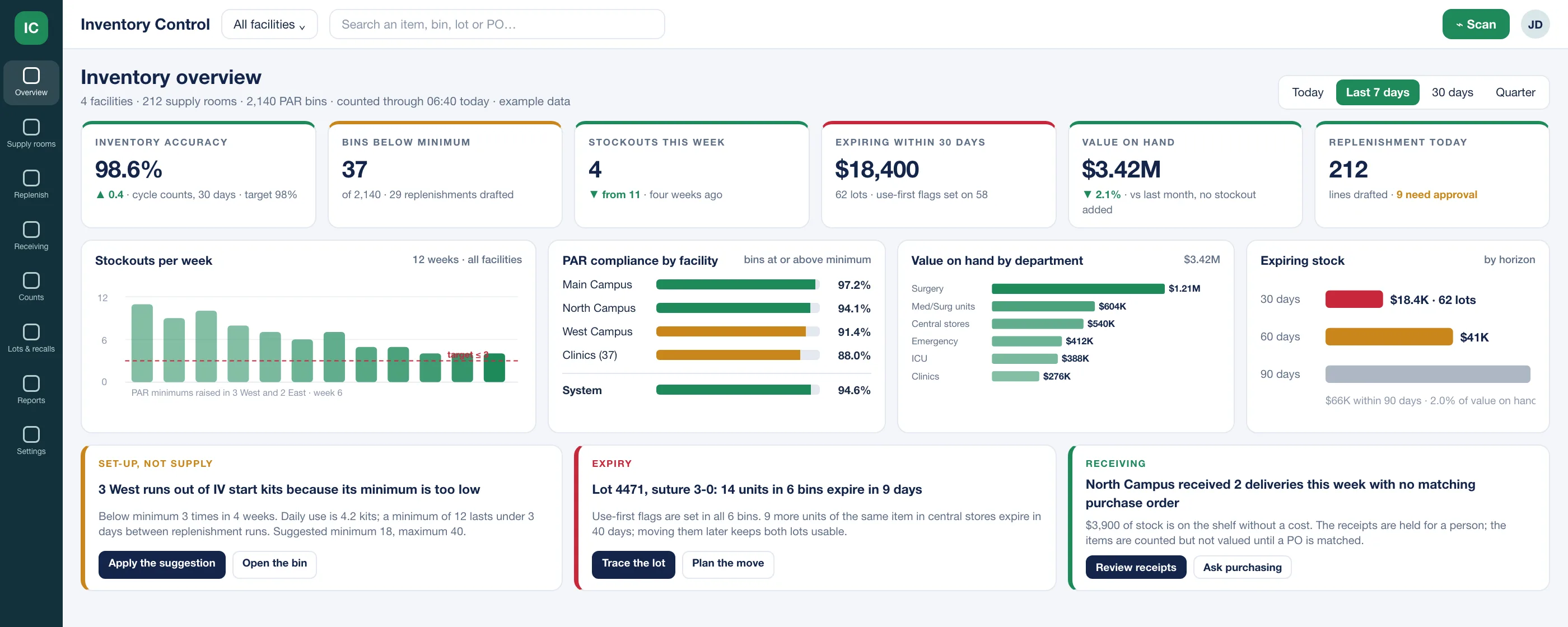
The overview
Where is the system short, over, or expiring?
Accuracy from the cycle counts, bins below minimum, stockouts by week, what expires in 30, 60 and 90 days, and value on hand by department — across every facility. The insight cards name a cause and propose the fix.
Swipe the screen sideways to read it.
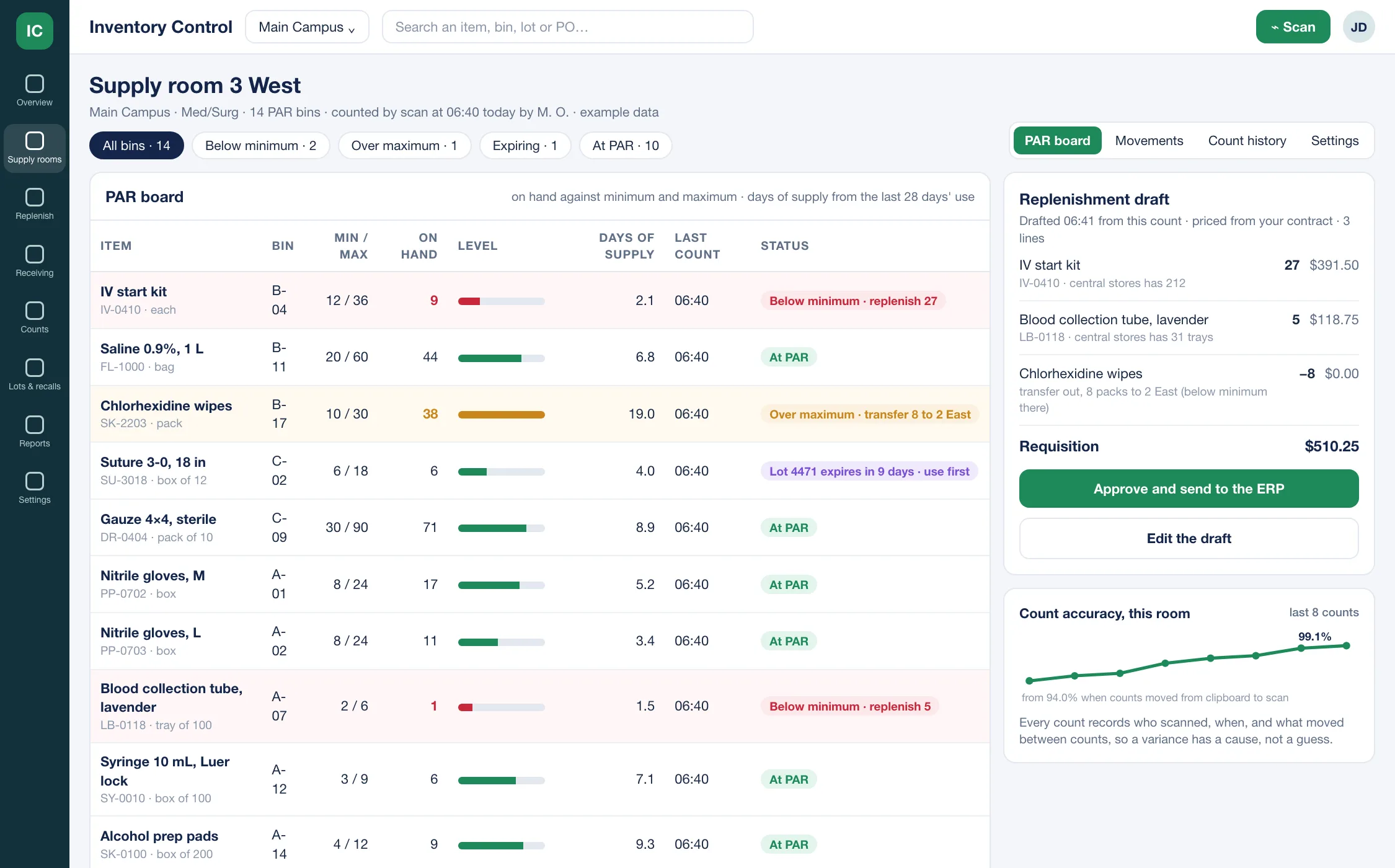
The supply room
Which bins need a person this morning?
One room after its count: every bin against its minimum and maximum, days of supply from the last four weeks of use, and the three that need a person. The replenishment draft beside it was priced from your contract the minute the count finished.
Swipe the screen sideways to read it.
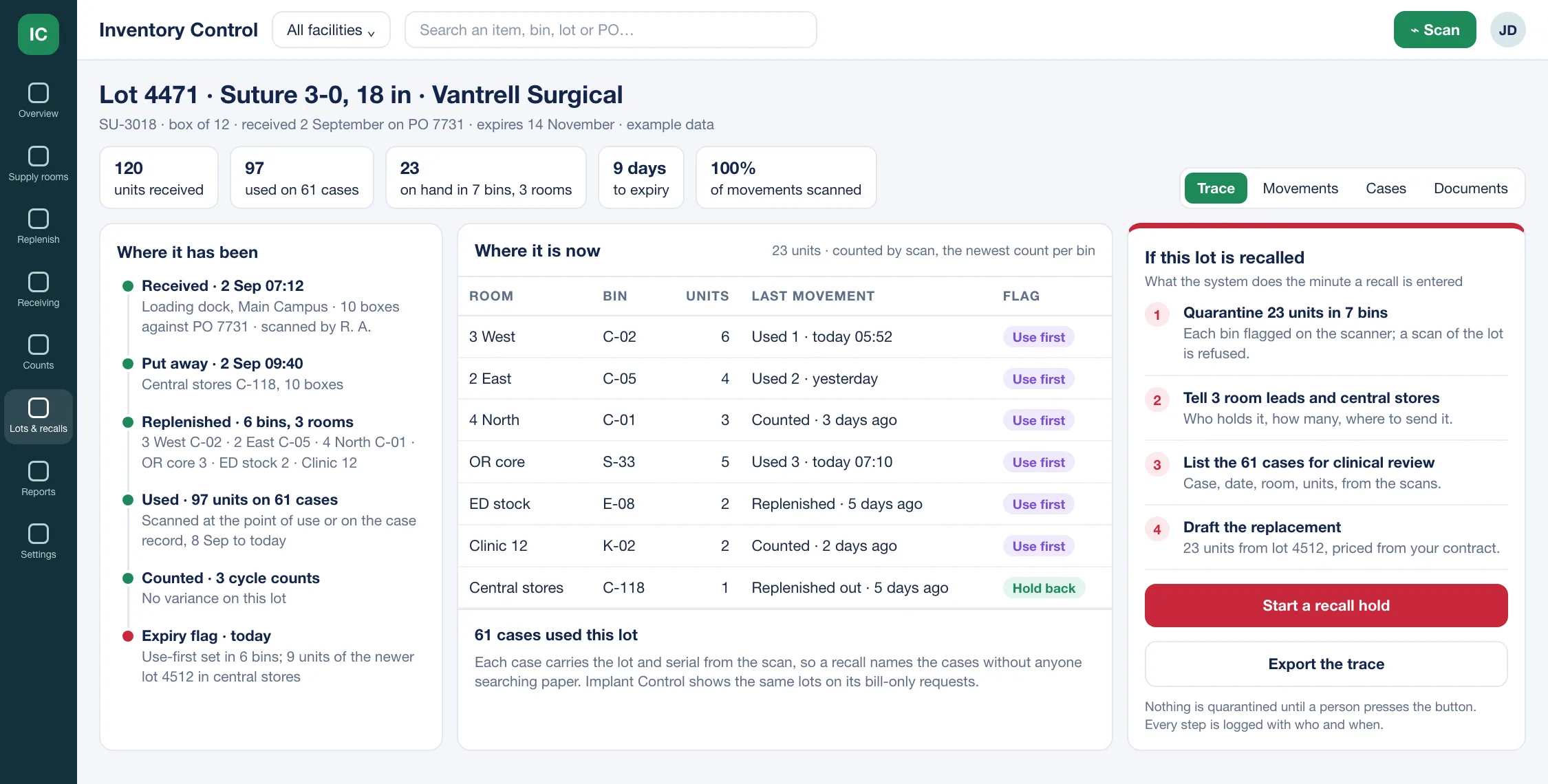
The lot trace
Where is this lot, and what happens in a recall?
One lot from the loading dock to the shelf: when it was received and against which PO, which bins it went to, which cases used it and how many units remain where. A recall hold quarantines, notifies and lists the cases — and starts only when a person presses the button.
Swipe the screen sideways to read it.
Where it works
From the floor to the boardroom.
AIMS is not a finance tool bolted on at the end. It follows the same chain your people already work in — and closes the gap between what happens on the floor and what leadership is told.
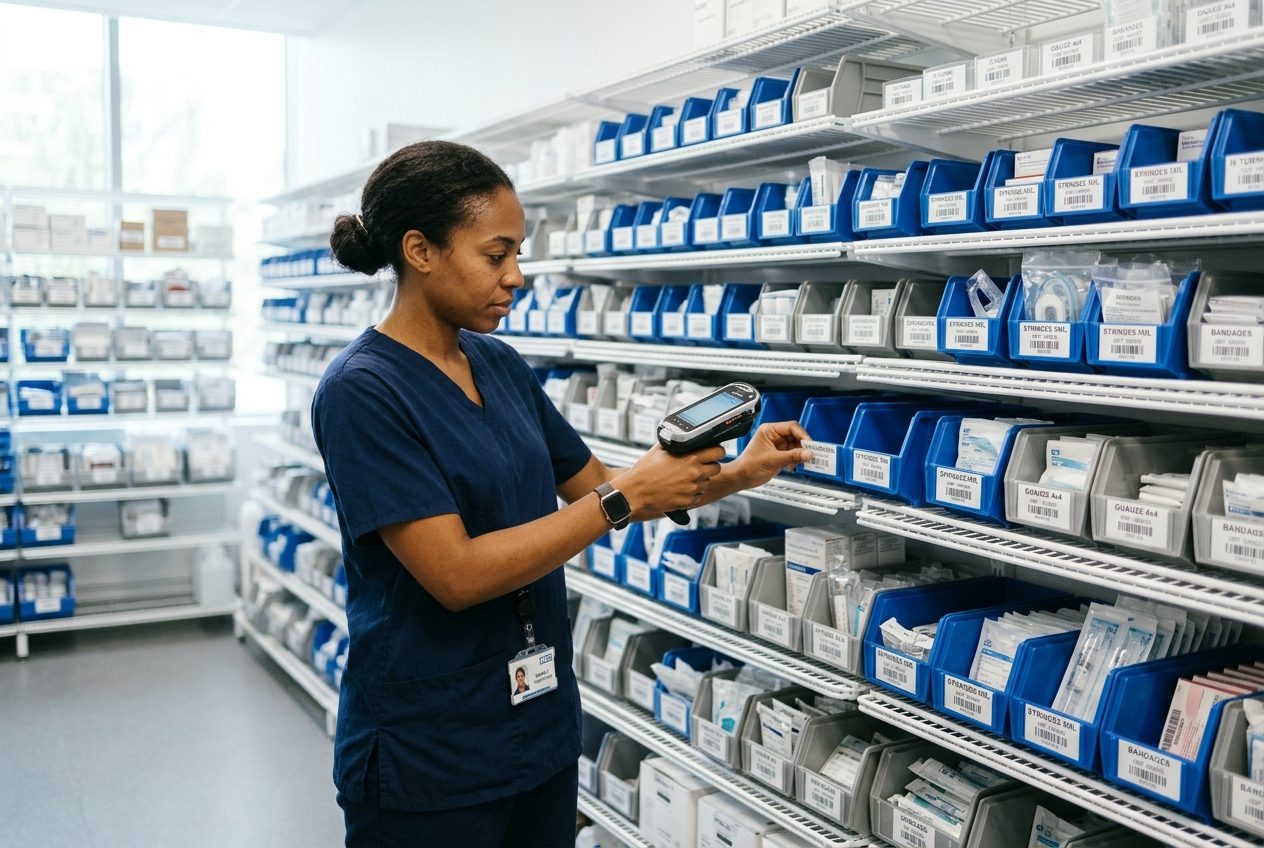
In the supply room
A clipboard walk-round tells you what was on the shelf when somebody last had time to look. A scan tells you what is there now.
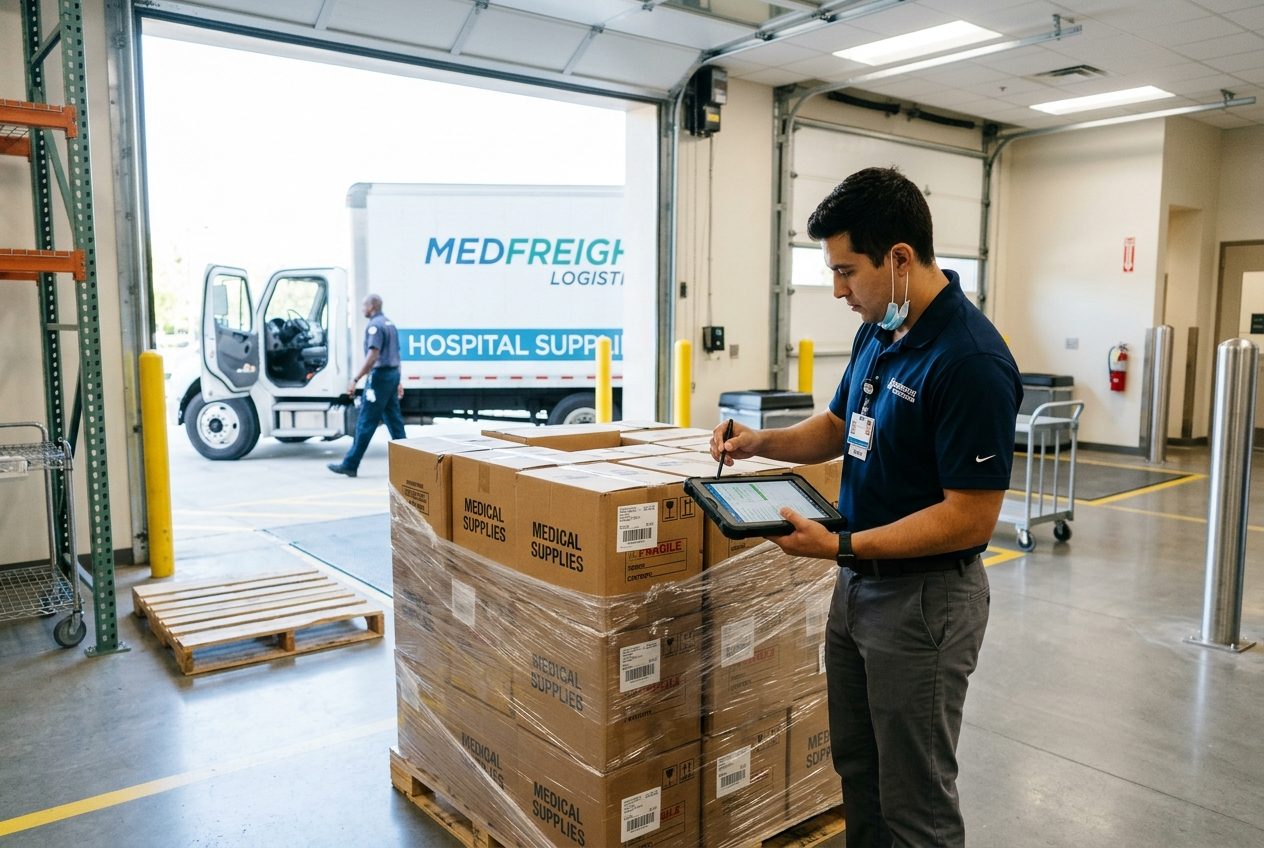
At the dock
Lot and expiry are captured once, against the purchase order, at the door. Everything downstream depends on that one scan.
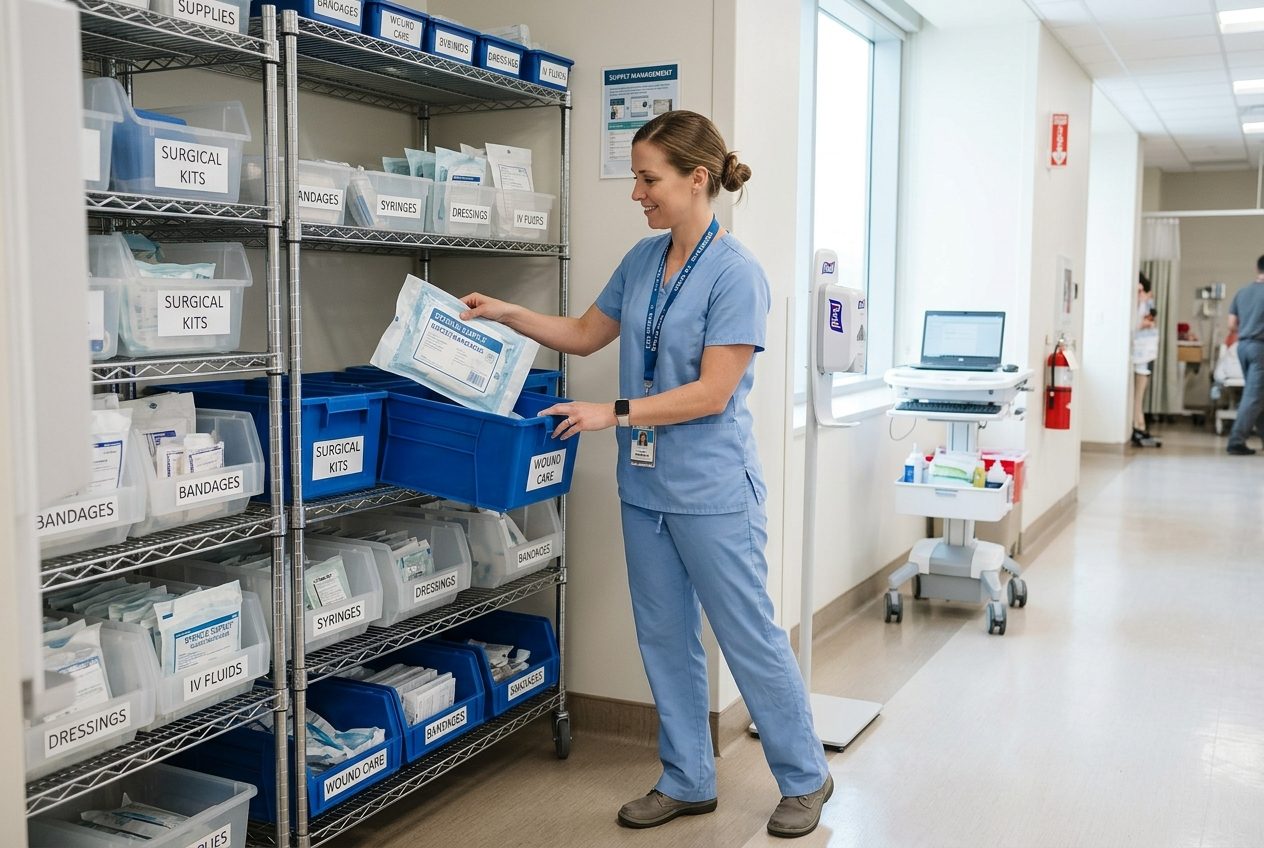
On the ward
Nobody should run out mid-morning. The short bins are already on a draft before the shift starts.
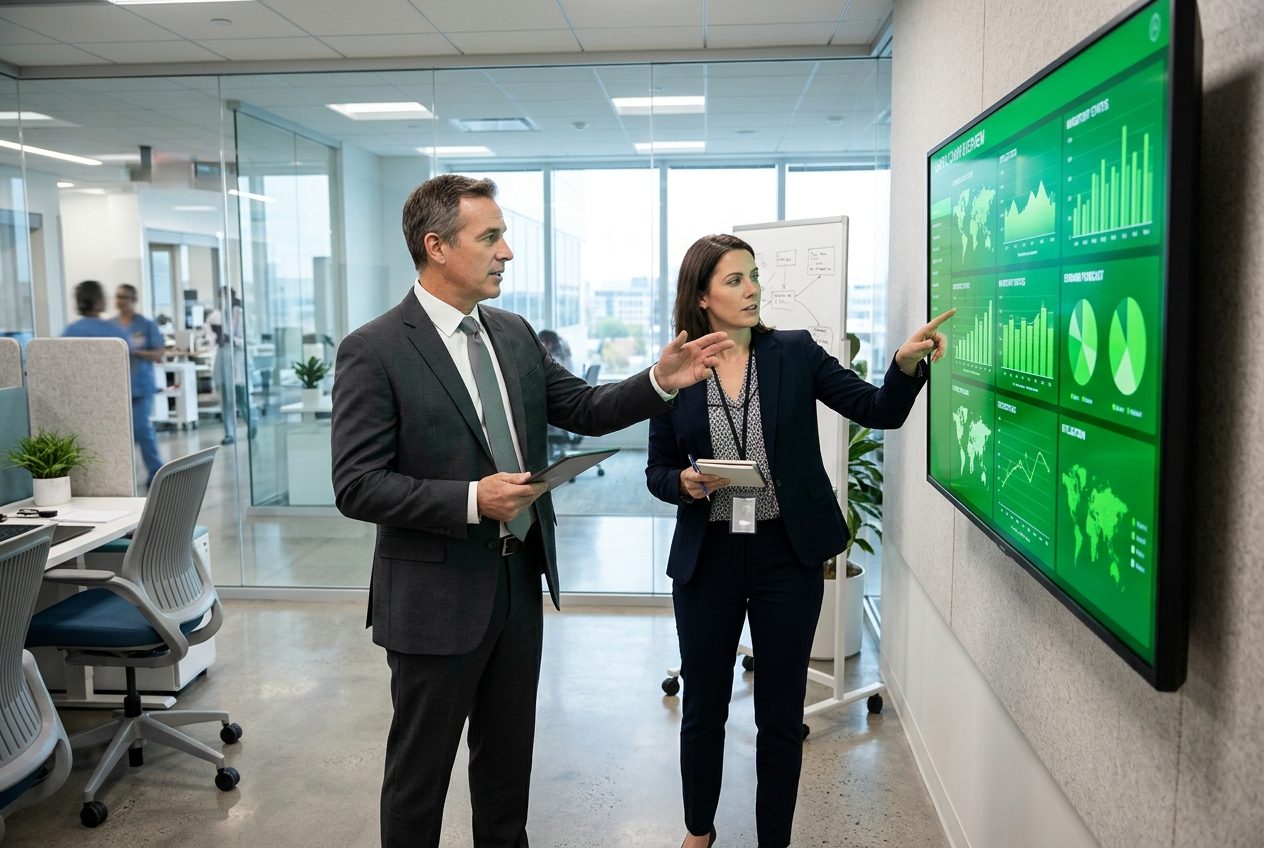
In the review
Value on hand by room, expiring stock as a figure rather than a surprise, and accuracy you can defend against the count.
Competencies
What the system is expected to be good at.
- 01PAR modelling and exception-based replenishment across every supply room in a system
- 02Barcode transaction capture on the scanners you already own, with RFID and cabinet reads taken in by integration
- 03Lot, serial and expiry traceability from receipt to point of use, with a full audit trail
- 04Recall execution with quarantine, notification and case review
- 05Item master, location and bin data migration with validation and reconciliation
- 06Value on hand and expiring stock reported to finance as a figure
Who it is for
The people who sign off on it.
Licensing is quoted per health system after a scoping call, based on facilities and modules. Ask for the walkthrough first — the numbers follow the scope, not the other way round.
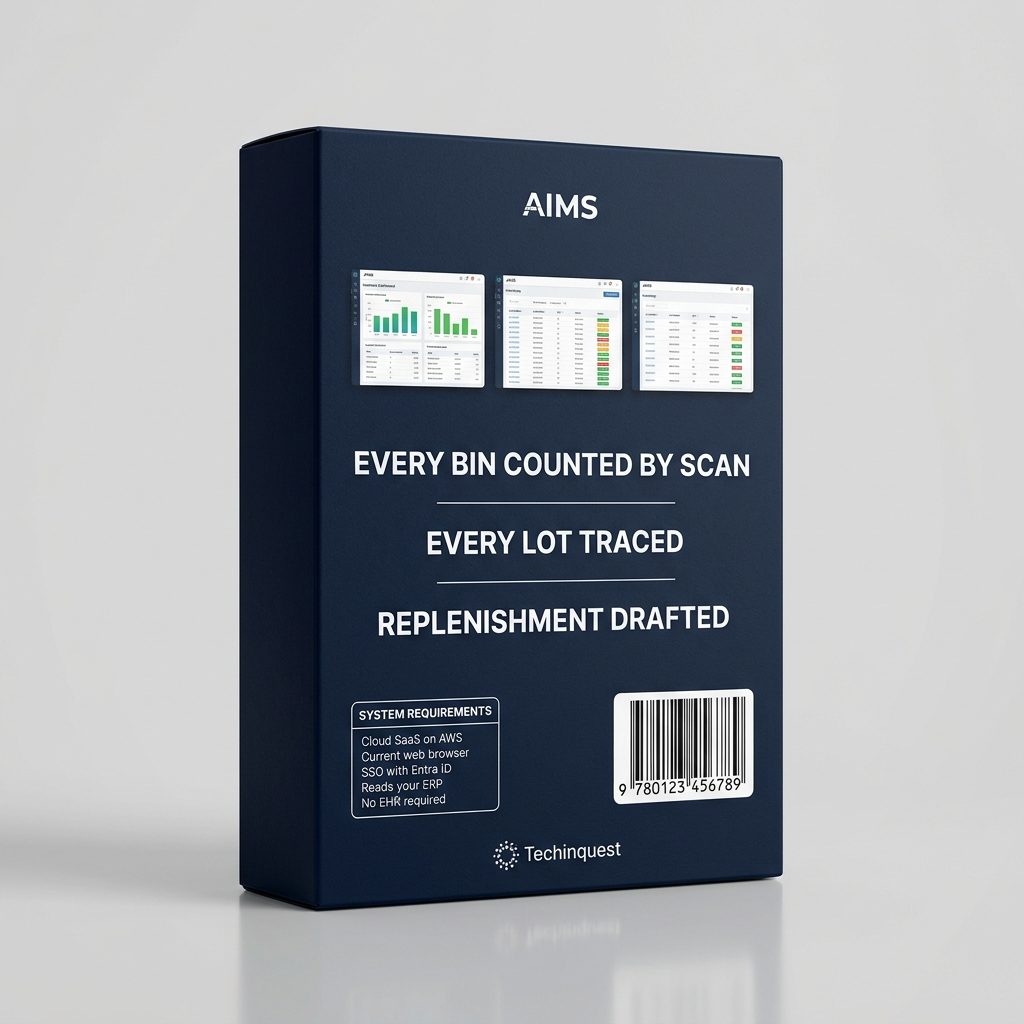
On the back of the box
Printed on the back
Every bin counted by scan
On hand is measured against the PAR you set for each bin — minimum, maximum and the pace it is actually used at — instead of being estimated on a walk-round.
Every lot traced
Lot, serial and expiry travel with every unit from receiving to use, so expiring stock is flagged use-first and a recall names every room, bin and case it reached.
Replenishment drafted
The count produces the order. It is priced from your contract and sent to your ERP as a requisition only once a person approves it.
System requirements
- Deployment
- Cloud SaaS hosted on AWS, with separate development, test and production environments.
- Browser
- Current Chrome, Edge, Safari or Firefox. No plug-ins required.
- Devices
- Desktop, laptop, iPad and iPhone. Responsive to the device in hand.
- Identity
- Active Directory and SSO via Microsoft Entra ID with MFA. Role-based access control.
- Data source
- PeopleSoft, Workday, Oracle, Infor, SAP or Dynamics 365 — by the ERP's own interface or scheduled secure file exchange. No EHR integration required.
- Network
- Standard HTTPS over port 443. No inbound firewall changes.
- Security
- Encrypted in transit and at rest, with immutable audit logging. HIPAA-compliant handling under a Business Associate Agreement.
- Implementation
- Configured, migrated, tested and trained with the Techinquest engineering team.
Compatibility
It fits what you already run.
Runs in the browser
Cloud SaaS on AWS, with development, test and production environments. Nothing to install, no servers to rack.
Every device, same experience
Desktop, laptop, iPad and iPhone — the interface follows the user.
Reads your ERP, not your EHR
Fed from PeopleSoft, Workday, Oracle, Infor, SAP or Dynamics 365 by the ERP's own interface or scheduled secure file exchange. No Epic integration required; a clinical interface is scoped like any other when a workflow needs one.
Active Directory and SSO
Entra ID with MFA and role-based access that mirrors how your organisation is already structured.
Encrypted in transit and at rest
Secured data stores with immutable audit logs, HIPAA-compliant under a Business Associate Agreement.
Runs alongside your GPO
No membership change, no contract migration, no rip and replace.
Implementation kit
What your team is handed at kickoff.
Nothing ships in a box, but the kickoff is still a handover. This is what your team receives in the first session, and what we are accountable for delivering before go-live.
First deliverable · AIMS
One of your supply rooms, loaded
Bring one room's PAR list and a month of its issues. We load the bins, run a count against your own figures and hand you the replenishment draft the count produces — before you commit to anything.
01
Scoping and configuration workbook
The facilities, entities, modules and approval structure we are configuring, written down and signed off before anything is built.
02
Integration specification
The exact fields we read from your ERP — PeopleSoft or any other — the extract schedule, the identity mapping and who owns each side. Reviewed with your IT team, not around them.
03
Named implementation lead
One engineer from Techinquest who runs your build, attends your calls and stays through go-live. Not a ticket queue.
04
Data migration and reconciliation plan
Item master, inventory locations and bin data imported, validated and reconciled against your own figures, with every discrepancy listed and resolved before go-live.
05
Configured dev, test and production environments
Your own environments loaded with your migrated data, so unit, system, integration and user acceptance testing all run against real records before go-live.
06
Role-based training, onsite and virtual
Separate sessions for supply chain staff, clinical users, system administrators and IT support — delivered live, recorded, and left behind as reusable material for future onboarding.
07
Go-live runbook and hypercare
A dated cutover plan with owners, followed by a defined hypercare window with direct access to the engineering team.
08
Quarterly review cadence
A standing review of what the system found, what it is worth and what to tune next. The handover does not end at go-live.
Request a walkthrough
See AIMS against your own numbers.
A working session with the Techinquest engineering team, scoped to your facilities and the systems you already run. We will show the product, not slides.
Built by Techinquest. Distributed and implemented by Sterile Mate.